
By Gerhard P. Herbig, gph@herbig-3d.de
Questions and answers concerning stereo photography, mounting and stereo projection.
Q: What should I consider when I’m working in the field of stereo photography?
A: There are exactly three basic rules which must be considered:
1. The first one with Shooting the stereo image
2. The second one with Mounting of the stereo image
3. The third one with Viewing of the stereo image – hand-held or projected
For highest stereo enjoyment, the application to all three basic rules is not only necessary but is also sufficient. All further stereo laws, requirements and rules can be derived from these three basic rules
1. The Shooting Rule:
The depth information in a stereo image must not exceed certain limits!
Q: Why should we observe the shooting rule?
A: Since our brain can process only a limited amount of depth information, the depth contained in a stereo image must be limited so that the entire stereo picture can be observed as a uniform spatial image. A violation of the shooting rule leads to a decay of the spatial image into individual image sections. If we want a stereo photo that is pleasant to view, adherence to the shooting rule is a condition which should be kept to under all circumstances.
Q: Which values and tolerances are dependent upon the shooting rule?
A: While taking a stereo picture, the spatial depth produces a lateral displacement of the two corresponding points in the left and right stereo images. For close objects this displacement is larger – and it is smaller for distant objects. One calls the difference between the largest (produced by the ‘closest object’) and the smallest (produced by the ‘most distant object’) displacement deviation or maximum parallax. The deviation should not exceed 1/30 of the entire image width (For the experts: this value follows from the 70′ condition).
Note 1: If the subject allows it, also the space in front of the stereo window can be used. For these cases the deviation limit is increased with the exact value depending on the subject. For the parts of the image that are in front of the stereo window, an additional deviation up to 1/50 of the image width may be generally well accepted.
Note 2: The restriction on the deviation to 1/30 of the image width always refers to the same detectable image area without twisting the head. For example, if the projected stereo image is so large that it can no longer be perceived at the same time, the maximum deviation value should be reduced accordingly. For cinema projection with very large screens, therefore, a reduced deviation of 1/40 of image width is recommended.
Note 3: For presentations of varying aspect ratios every individual maximum deviation values must be related to the image width of the widest image. For portrait images, this leads usually to significantly higher maximum deviation values.
Note 4: The maximum lateral offset of 1/30 of the image width is to be understood as an upper limit and can, in individual cases even be too large, especially when the nearest point and the farthest point in a stereo image are precisely cutting.
Q: How do I keep to the shooting rule?
A: A very simple condition for keeping to the shooting rule can be derived from some geometrical considerations:
Distance to closest point > Stereo base times focal length (all values in mm).
The distance to the closest point is the distance between the camera and the point at the very front of the subject. The stereo base (separation of the lenses) is about 65 mm at true stereo cameras. Specially in the older literature one can often find rough formulas with only a solid value (for example 35 or 50) instead of the true focal length. Since most stereoscopic cameras sold today have zoom lenses with adjustable focal lengths, these simple formulas only have a restricted value. The separation condition given above is valid for all subjects, which include the infinite point (e.g. the horizon) as a part of the image.
When taking pictures, one only needs to ensure that no object is closer to the camera than the allowable distance of the closest point, calculated using the above rule, thus for example 2.3m with 35 mm focal length, 3.3 m with 50 mm focal length or 4.5 m with 70 mm focal length (assumed 65-70 mm stereo base). This condition should be modified to some degree if the distant point is not situated at infinity. In these cases refer to a special literature (e.g. Stereoscopy, Dec. ’95, pp 24-25 for close-ups) or do some trial and error tests and calculations for yourself.
A simple estimation of the permissible stereo depth is possible also by comparison with the sharpness depth: Thus with stereo cameras with 65-70 mm stereo base the admissible stereo depth corresponds rather exactly to the sharpness depth zone of a 35 mm-lens with stop 8, of a 50 mm-lens with stop 11 or of a 70 mm-lens with stop 16. Violations of the shooting rule cannot be corrected during mounting or during projection.
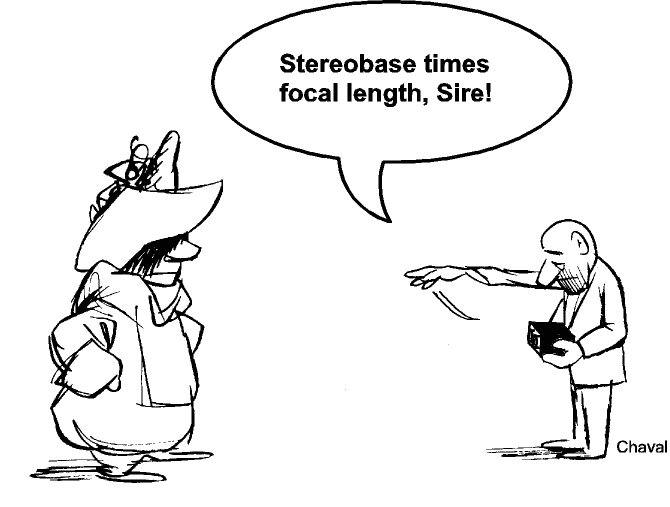 |
| Shooting Rule: Beware of the minimum shooting distance! |
2. The Mounting Rule:
No part of the spatial image may be cut by the stereo window of the frames (mounts)!
Q: Why should the mounting rule be kept?
A: With stereo projection (and when looking into a stereo hand viewer) the spatial image is usually observed behind an apparent window. This window is called the ‘stereo window’. Actually the stereo window is the spatial image of the stereo frame. Whether the image scenery is seen to be before or behind this stereo window is exclusively dependent on the position of the single film chips within the stereo mounts.
The stereo window is observed as a fixed wall. With a violation of the mounting rule, the spatial image is often too far in front of the stereo window and parts of the picture seem to penetrate or “impinge on” the wall. This ‘erroneous image’ leads to a clearly reduced enjoyment when looking at spatial images. However, the mounting rule is only a search for a technique or rule, i.e. it should be kept, but it doesn’t have to be kept under all circumstances.
Q: What limit values and tolerances are experienced during the application of the mounting rule?
A: The mounting rule is an aesthetic requirement. Stereo images, which violate this demand can be viewed, nevertheless, fatigue-free. Adherence to the mounting rule leads mostly to the fact that the entire picture is observed behind the stereo window. Since with commercial 3D-movies, effects are frequently more spectacular than aesthetic. One finds that most violations of the mounting rule are there by conscious setting the spatial image completely in front of the stereo window.
Only free-standing objects, which are completely situated within the frame and in the foreground part of the scenery – for example, a frontally taken shot of an elephant’s trunk – is in agreement with the mounting rule and should stand out from the stereo window i.e. the trunk is seen to protrude through the stereo window. Further popular examples are: the pump lever over the well whose water stream squirts into the audience,- the animal, which stretches its head into or through the stereo window,- the bird or the insect, which flies in front of the stereo window and so on.
Q: How do I avoid breaking the mounting rule?
A: With the help of the RBT mounts with plastic guides, the film chips can be easily and accurately positioned within the mounts. By pulling them apart the spatial image moves to the rear, by pushing them together, it moves forward. The optimal position is achieved when the spatial image
is as far to the front as possible,
but as far to the back as necessary
according to the mounting rule. Then the closest point actually touches the stereo window. The spatial scenery starts tightly behind the window and no space between the stereo window and the closest point is wasted). (This type of mounting is often called: “closest-point mounting”, is very critical and violations are difficult to avoid). A less critical solution is to plan for a small space between the stereo window and the closest point. Remember – violations of the mounting rule cannot be corrected with projection.
 |
| Mounting Rule: Set only free-standing objects in front of the stereo window! |
Note: For 3D video with frequently changing motifs and scenes, near point framing can lead to an undesirable disturbance at the far point, in the worst case the farthest point jumps from scene to scene forth and back. To avoid this, notwithstanding the recommendation formulated above, the farthest point will be assigned constant disparity, for example, 1/30 or 1/40 of the image width. This form of image mounting is called far point mounting. Using this kind of framing, the mounting rule is fullfilled automatically (no stereo window violation!), if the shooting rule was met. For problematic images with a bit too much depth, floating stereo windows within the image may help.
No person viewing a projected stereo image should be forced to diverge his eyes.
Q: Why should the projection rule be kept?
A: When seeing into the distance the axes of the two eyes are parallel, whereas seeing into the near proximity one finds that the eyes converge somewhat inwards. However, diverging eye axes never occurs in natural vision. If one is still forced to observe stereo images for a longer time using diverging eye axes, headache is the inevitable result. Even if some older ‘stereo hares’ are capable of fairly amazing eye gymnastics, looking at stereo should be enjoyable for each viewer. The projection rule is therefore a discipline which needs to be kept under all circumstances with any stereo projection show.
Q: According to the rule, what limits are there on values and tolerances during stereo projection?
A: When distant objects are seen in the natural world, the eye axes are parallel. When such objects are stereo-projected, a background screen separation of about 65-70 mm equates to natural vision. Small increases are surely permitted. They should, however, be not more than about 10 mm for each 1 m projection distance (this gives an excess of 50 mm over a 5 m distance, 100 mm during 10 m distance and so on). The eye comfort of members of the audience, who are seated close to the screen, needs to be considered. (for the experts, the technical literature indicates an angle of 1º is the max. admissible divergence. However, experiences of the author leads to the conclusion that many spectators suffer definite eye fatigue symptoms!).
Q: How do I keep to the projection rule?
A: If the shooting and the mounting (framing) have been faithfully carried out, adherence to the projection rule is child’s play. A stereo slide, which contains the infinity point, is projected and with the control knob, lateral separation of the two infinity points can be adjusted at 65-70 mm on the screen. (For mono projectors the whole projector has to be moved). With this methodology the stereo window can quite easily be situated in front of the screen!
Only during a home projection with limited projection enlargement can, for the sake of simplicity, the stereo window be put exactly at the screen level. With projections in larger halls, this procedure is not recommended, because 3D-viewing of objects nearby is so much more enjoyable than it is of objects far away.
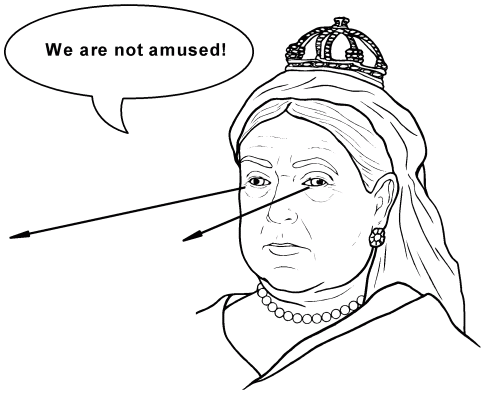 |
| Projection Rule: Avoid diverging eye axes! |
[1] Gerhard P. Herbig: Commentary to the Review of the Stereo Calculators. Stereoscopy, Series 2 – Number 25.
Further Information you can get from the ‘Deutsche Gesellschaft für Stereoskopie e.V.’, http://www.stereoskopie.org